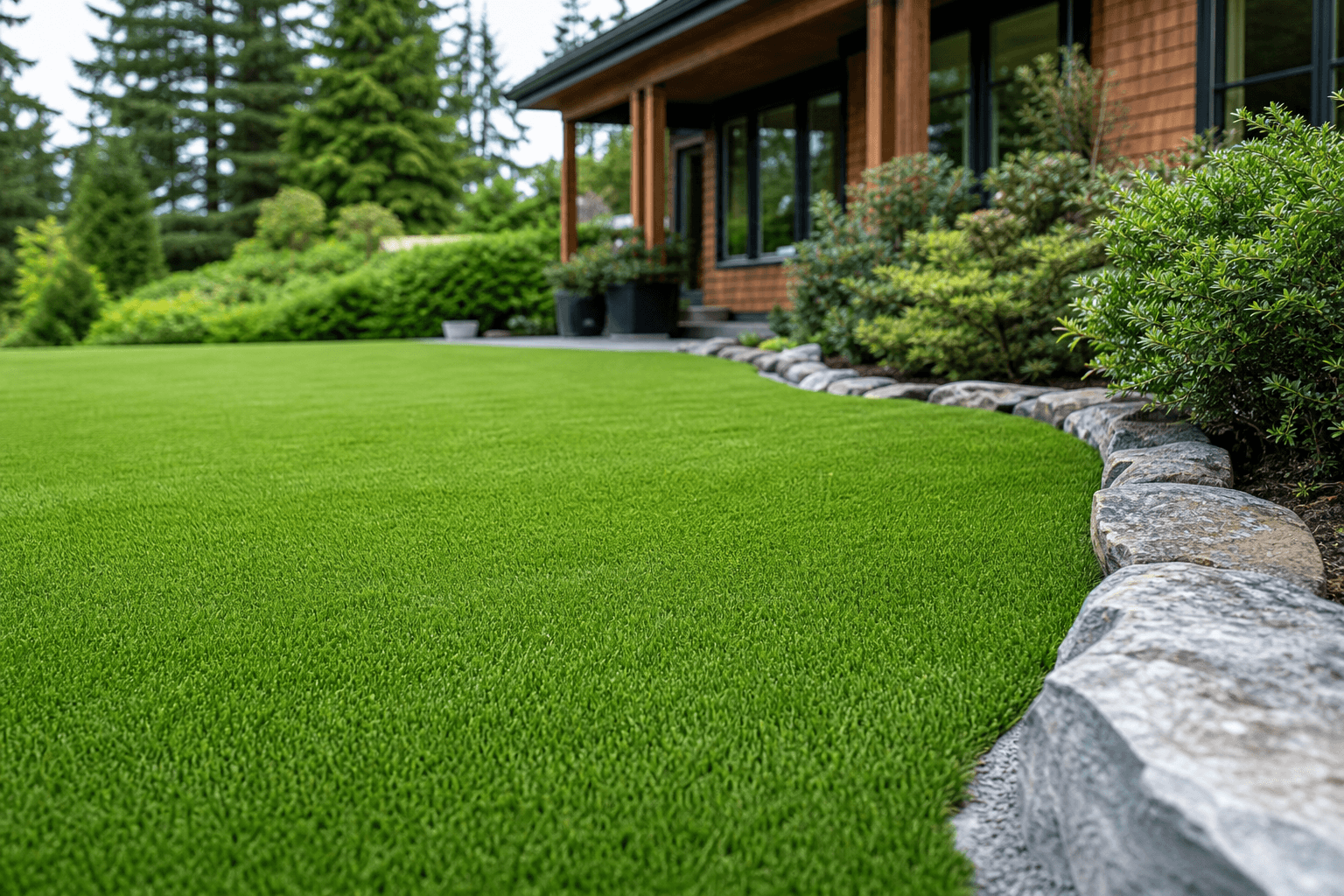
The three things killing your Surrey lawn
Natural grass needs three things our climate makes hard: drainage, sunlight, and a dry-enough dormant season. Surrey gives it none of those from October to April. Let's break down why.
1. Clay soil that won't drain
Most of Surrey sits on dense glacial clay. Clay holds water like a bathtub. When the fall rains roll in off the Pacific, that water has nowhere to go, so it sits in the root zone. Roots that sit in waterlogged soil rot and suffocate. That's the muddy, spongy feeling you get walking across the yard in January.
2. Shade from big trees
Surrey's mature cedars, firs, and the canopy in older neighbourhoods like Ocean Park and parts of Guildford block the low winter sun. Grass needs light to photosynthesize and recover. In deep shade it just thins out, and moss, which loves shade and damp, moves in to take its place.
3. Moss thrives in exactly our conditions
Moss doesn't kill your grass. It fills the gaps your grass leaves behind. Wet, shaded, compacted, acidic soil is a perfect home for moss, and that describes a Surrey winter lawn almost exactly. You can rake it, treat it, and reseed every spring, and it comes right back the next winter because the underlying conditions never change.
Why patching and reseeding never sticks
Every spring, homeowners dump money into moss killer, lime, fresh sod, and seed. By the next winter the lawn looks the same. That's because the fixes treat the symptom, not the cause. The cause is the soil and the shade, and you can't change either one cheaply. This is the cycle that pushes so many people toward a permanent solution.
How artificial grass breaks the cycle
Synthetic turf sidesteps all three problems at once. There's no soil for water to pool in, because the turf sits on a compacted crushed-rock base that drains freely. There's no living plant that needs sunlight, so shade is irrelevant. And there's no soil for moss to root in, so the moss problem mostly disappears with a quick brush a couple of times a year.
The key, and the part cheap installs get wrong, is the base. A proper residential artificial grass installation starts by stripping the old sod and building a graded, free-draining base. Done right, fake grass actually drains faster than the lawn it replaces. No standing water, no mud, no moss, green all year.
Is it worth it in your neighbourhood?
For most of Surrey, yes, especially in the shaded, clay-heavy pockets. We see it constantly in areas like North Delta, where the clay soil holds water all winter, and in shaded older yards across the city. If you've reseeded the same patch three years running, the math usually favours a one-time turf install that lasts 15 to 20 years.
The honest answer on whether it's right for your yard comes from looking at it. We give free on-site quotes, measure the space, check the drainage, and tell you straight whether synthetic grass makes sense for you.